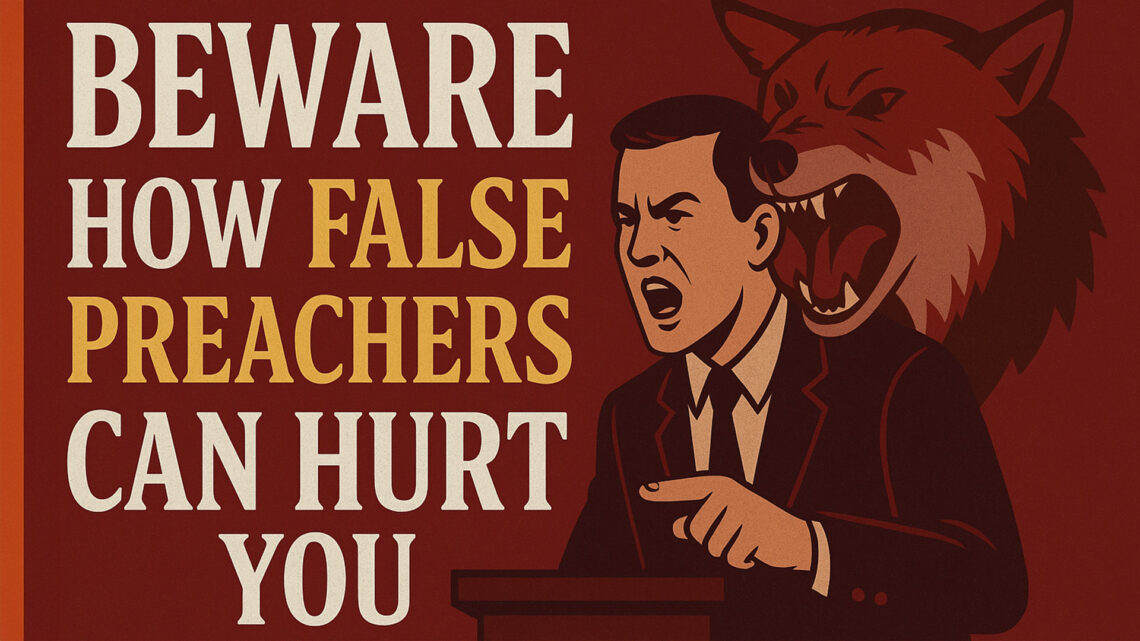
False teachers do not always look dangerous. They may appear confident, quote Scripture, attract a large audience, and use familiar Christian language. That is why learning how to identify false teachers matters. A persuasive personality, successful ministry, or religious vocabulary cannot prove that someone speaks for God.
- Scripture tells Christians to examine both a teacher’s message and life.
- The standard is not popularity, emotion, or personal preference; it is the Word of God understood in context.
- False teachers can distort the gospel, create false assurance, exploit people, and draw followers away from Christ.
- Believers must therefore practice careful, humble, biblical discernment.
Why False Teachers Are Spiritually Dangerous
The apostle Peter warned that false teachers would arise within the visible community of faith. Second Peter 2:1 (LSB) says that “there will also be false teachers among you” who secretly introduce destructive teaching. Their influence may begin quietly, but the damage is serious.
This does not mean that every teacher who makes a mistake or disagrees on a secondary issue is a false teacher. Faithful pastors remain imperfect and must be willing to receive correction. A false teacher, however, shows a persistent pattern of corrupting essential truth, resisting biblical correction, and using spiritual influence to lead others away from faithful obedience to Christ.
Jesus used even stronger language. Matthew 7:15 (LSB) warns, “Beware of the false prophets, who come to you in sheep’s clothing, but inwardly are ravenous wolves.” The danger is real precisely because deception often looks respectable.
How False Teachers Can Hurt You
False teaching is not merely an intellectual problem. What a person believes about God, sin, Christ, salvation, and Scripture shapes how that person lives.
A distorted gospel can give an unbeliever false assurance. Manipulative teaching can produce fear, misplaced loyalty, financial exploitation, or dependence on a personality instead of Christ. Teaching that excuses sin can deaden the conscience, while teaching that adds human works to the gospel can burden people with a righteousness they can never achieve.
No preacher can save you. Salvation is God’s gift of grace through faith in Jesus Christ, not a reward earned through rituals, donations, religious activity, or devotion to a ministry (Ephesians 2:8–9, LSB).
Eight Warning Signs of a False Teacher
1. The Teacher Distorts the Gospel
The gospel announces that sinners are saved by God’s grace through faith in Jesus Christ and His finished work—not through human merit. Paul treated corruption of that message as a grave offense. Galatians 1:8 (LSB) says that anyone proclaiming a contrary gospel is to “be accursed.”
Be alert when a teacher adds works as a condition for earning salvation, denies the necessity of repentance and faith, diminishes Christ’s deity or atoning work, or turns the gospel into a promise of health and wealth.
2. The Teacher Twists Scripture
Quoting a verse does not make a message biblical. Satan quoted Scripture while tempting Jesus, but he misused it (Matthew 4:5–7, LSB). Second Peter 3:16 (LSB) warns that the untaught and unstable “distort” the Scriptures “to their own destruction.”
A teacher should explain a passage in its literary, historical, and biblical context. A message built on isolated phrases, hidden meanings, or claims that cannot survive examination of the surrounding verses should not be trusted.
3. The Teacher Rejects Sound Doctrine
First Timothy 6:3–5 (LSB) contrasts the sound words of Jesus Christ with proud, corrupt teaching that produces controversy, envy, strife, and constant friction. Healthy doctrine leads toward godliness. False doctrine often replaces the meaning of the text with speculation, novelty, or whatever the audience wants to hear.
A faithful teacher submits personal opinions to Scripture. A false teacher tends to make personal insight function as the final authority.
4. The Teacher Uses Ministry for Greed
Money is not proof that a teacher is false, and faithful ministries may rightly receive support. The warning sign is exploitation. Second Peter 2:3 (LSB) says, “in their greed they will exploit you with false words.”
Be on the alert for constant pressure to give, promises that donations will force God to provide wealth, hidden financial practices, extravagant self-enrichment, or the suggestion that access to God’s favor can be purchased.
5. The Teacher Draws Disciples After Himself
Paul warned church elders that wolves would arise even from among them. Acts 20:30 (LSB) says such men speak perverse things “to draw away the disciples after them.”
Faithful teachers point people to Christ and handle authority as a stewardship. False teachers cultivate unquestioning loyalty to themselves, treat reasonable questions as rebellion, and make followers feel that leaving their ministry is the same as leaving God.
6. The Teacher’s Fruit Contradicts the Message
Jesus said, “You will know them by their fruits” (Matthew 7:16, LSB). Fruit must be evaluated over time. The question is not whether a teacher is flawless, but whether the life consistently displays humility, truthfulness, self-control, repentance, and love—or instead reveals deceit, sensuality, domination, greed, and unrepentant sin.
Public charisma cannot cancel private corruption. James 3:1 (LSB) reminds teachers that they “will receive a stricter judgment.”
7. The Teacher Resists Biblical Testing and Accountability
God does not ask Christians to believe every spiritual claim. First John 4:1 (LSB) commands, “do not believe every spirit, but test the spirits to see whether they are from God.” The Bereans were commended for examining the Scriptures daily to see whether Paul’s teaching was true (Acts 17:11, LSB).
Faithful teachers welcome careful examination of their doctrine. Be wary of leaders who forbid questions, isolate followers from other mature Christians, or claim a special revelation that places them beyond correction.
8. The Teacher Offers False Assurance
Religious words and impressive works do not prove that a person knows Christ. In Matthew 7:21–23 (LSB), Jesus warned that some who call Him “Lord” will hear, “I never knew you; depart from Me.” He was not teaching salvation by works. He was exposing an empty profession that lacks a genuine relationship with Him and the changed life produced by saving faith.
Any teacher who assures people that church attendance, baptism, repeating a phrase, giving money, or performing good deeds can save them is lying to you. Good works are the fruit of salvation, never its cause.
How to Protect Yourself From False Teaching
Biblical discernment is neither cynicism nor a search for reasons to attack other Christians. It is the humble practice of testing teaching by God’s Word.
- Know the gospel. Learn what Scripture teaches about God, sin, Christ, repentance, faith, grace, and salvation.
- Read passages in context. Examine the verses before and after a quotation and compare the message with the whole counsel of Scripture.
- Evaluate doctrine and character. Listen to what a teacher says and observe the teacher’s fruit over time.
- Seek a faithful local church. Mature, biblically qualified elders provide shepherding and accountability that online personalities cannot replace.
- Do not ignore serious warning signs. If a leader persists in destructive error or unrepentant corruption, leave that assembly immediately.
- Remain humble. Every Christian depends on God’s grace and must be willing to have personal beliefs corrected by Scripture.
You can also watch this short video about false preachers for a concise introduction to the warning.
What If You Have Followed a False Teacher?
Do not allow embarrassment or fear to keep you in deception. Bring the teaching into the light of Scripture. Reject what is false, seek help from trustworthy church leaders, and return to the truth of the gospel.
If you are uncertain about your salvation, do not look first to a past experience, religious activity, or a preacher’s assurance. Look to Jesus Christ. Only God saves. Turn from trusting yourself and place your faith in Christ—His perfect life, sacrificial death, and resurrection. If you would like to speak with someone or request prayer, contact TreasureTop Ministries.
Conclusion
False teachers can be persuasive, popular, and difficult to recognize, but God has not left His people defenseless. Scripture reveals the warning signs: a distorted gospel, twisted Bible passages, rejected doctrine, greed, self-promotion, corrupt fruit, resistance to accountability, and false assurance.
Do not measure a teacher by charisma alone. Test the message, examine the fruit, remain connected to a faithful church, and hold fast to Jesus Christ and His Word.
Key Takeaway
False teachers harm people and produce false Christians by leading them away from the truth of Christ. In one sense, a false teacher can be a part of sending someone to hell because he thought he was a Christian. Christians must test every message by Scripture, paying attention to both doctrine and character. This is why it’s very important to spend time in the word of God every single day: to learn the truth, to read the truth for yourself, not to be filtered through someone else’s lens.
Discernment is not suspicion for its own sake. It is a faithful response to God’s command to guard the gospel, protect the church, and follow Christ rather than a personality.
Learn More
To continue studying what the Bible teaches, you may also enjoy these related articles on TreasureTop:
- How Do I Know If I Am Really Saved?
- What Does It Mean to Be Born Again?
- Does the Bible Contradict Itself?
- What We Believe
Send Us Your Prayer Request
2 Questions Many Ask
- Am I Truly Saved? Discover the answer — 👉 Click here.
- Why Self-Help Books Don’t Work Long-Term: 👉 Find out. Click here.
Prayer Request?
- If you have a prayer request or comments, 👉 click here.
Find Us Here
- Visit our YouTube channel by clicking here.
- Visit our Facebook page here.
- Subscribe to our audio podcasts:
Scripture quotations taken from the New American Standard Bible 1995® (NASB), Copyright © 1960, 1962, 1963, 1968, 1971, 1972, 1973, 1975, 1977, 1995 and from the Legacy Standard Bible © 2021 by The Lockman Foundation. All rights reserved. www.lockman.org