By Pastor John Haggard
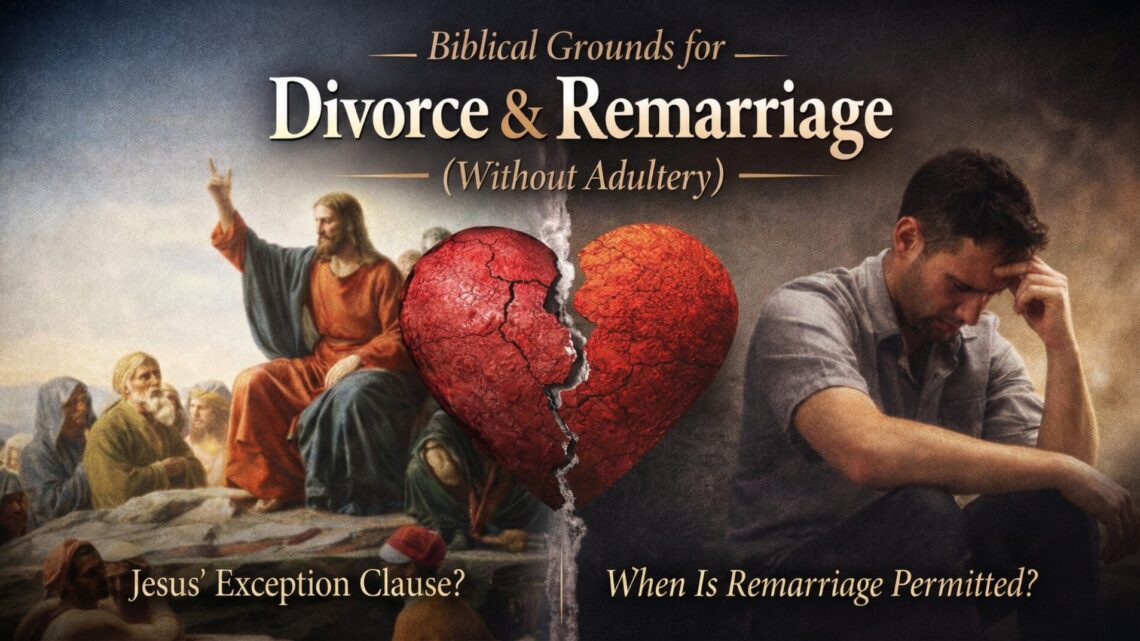
What Are the Grounds for Biblical Divorce and Biblical Remarriage? Can You Remarry Without Committing Adultery?
To answer this question, this point is critical: we must let Scripture interpret Scripture rather than relying on man’s opinion.
2 Peter 1:20–21 (LSB):
“Know this first of all, that no prophecy of Scripture comes by one’s own interpretation. For no prophecy was ever made by the will of man, but men being moved by the Holy Spirit spoke from God.”
This means that it is God’s word, not man’s interpretation, that dictates the truth.
Are There Very Few Biblical Reasons for Divorce?
- Adultery is presented in the Old Testament as the only acceptable reason for dissolution, much as Jesus stated in the New Testament that immoral sexual involvement is the only grounds for divorce.
- Divorce is a last resort rather than a choice that is taken lightly because Jesus recognized that it tackles hard-heartedness that is demonstrated by a blatant, unrepentant pursuit of sexual immorality.
- Marriage is meant to last a lifetime according to God’s design. A one-flesh covenant intended to last a lifetime is marriage.
Genesis 2:24 (LSB):
“Therefore a man shall leave his father and his mother, and cleave to his wife; and they shall become one flesh.”
In a fallen society, divorce is viewed as a compromise rather than as God’s will. A fallen world represents creation fundamentally altered by humanity’s rebellion against God — the difference between the created world as God originally made it and the fallen world known through history, a world marred by evil rather than characterized by primal innocence. Every aspect of life in this world has been altered by human sin.
What Are the Two Biblical Grounds for Divorce?
Sexual Immorality
Jesus said in Matthew 5:32 (LSB),
“But I say to you that everyone who divorces his wife, except for the reason of sexual immorality, makes her commit adultery; and whoever marries a divorced woman commits adultery.”
Jesus’ “exception clause” is taken to mean that persistent, unrepentant sexual sin violates the marriage covenant in a way that permits divorce for the innocent party.
Abandonment by an Unbelieving Spouse
The Apostle Paul who wrote down the Holy Spirit-inspired word of God and who wrote 13 of the 27 books in the New Testament, penned this in 1 Corinthians 7:12–15 (LSB):
“But to the rest I say, not the Lord, that if any brother has a wife who is an unbeliever, and she consents to live with him, he must not divorce her. And a woman who has an unbelieving husband, and he consents to live with her, she must not divorce her husband. For the unbelieving husband is sanctified through his wife, and the unbelieving wife is sanctified through her believing husband. For otherwise your children are unclean, but now they are holy. Yet if the unbelieving one leaves, let him leave. The brother or the sister is not enslaved in such cases, but God has called us to peace.”
If an unbelieving spouse deserts the marriage (initiates separation/divorce), the believer is “not under bondage” (not bound) in that scenario.
When Is Remarriage Permitted?
Remarriage is permitted only after a divorce that was based on biblical grounds.
- If there is a sexual-immorality case, it is understood that the innocent party is free to remarry.
- In the abandonment-by-unbeliever case, the deserted believer is likewise understood to be free to remarry.
Is Remarriage After an Unbiblical Divorce Considered Adultery?
If someone divorces without biblical warrant and remarries, such remarriage is adultery. In Mark 10:11b–12 (LSB), Jesus said,
“Whoever divorces his wife and marries another woman commits adultery against her; and if she herself divorces her husband and marries another man, she is committing adultery.”
What If Someone Already Has an Unbiblical Divorce Behind Them?
The responsibility is to remain unmarried and seek reconciliation where possible, unless the former spouse is living in ongoing, unrepentant adultery (which would invoke the sexual-immorality ground).
The Apostle Paul wrote in 1 Corinthians 7:10–11 (LSB),
“But to the married I give instructions, not I, but the Lord, that the wife should not leave her husband (but if she does leave, she must remain unmarried, or else be reconciled to her husband), and that the husband should not divorce his wife.”
What happens if I have experienced such in the past but have since turned to Jesus Christ for salvation?
Let’s say you have been married once and gotten divorced. Or that you may have had multiple marriages and divorces. In this situation, 1 Corinthians 6 offers us some genuine hope and clarity. The apostle Paul states in 1 Corinthians 6:9b-11,
Or do you not know that the unrighteous will not inherit the kingdom of God? Do not be deceived; neither the sexually immoral, nor idolaters, nor adulterers, nor effeminate, nor homosexuals, nor thieves, nor the greedy, nor drunkards, nor revilers, nor swindlers, will inherit the kingdom of God. And such were some of you; but you were washed, but you were sanctified, but you were justified in the name of the Lord Jesus Christ and in the Spirit of our God.
This means that regardless of the type of sinner and God-offender you were in the past, it doesn’t matter who you were before you came to saving faith in Jesus Christ. The old things fall away and everything becomes new when you have a saving trust in Jesus Christ. You receive a fresh start when you dedicate your life to Jesus Christ. And from now on, you must live a life that glorifies God.
Does Death End the Marriage Bond and Permit Remarriage?
A separate “ground” that ends marriage is death, which ends the marriage bond and permits remarriage.
Romans 7:1–3 (LSB):
“So then, if while her husband is living she is joined to another man, she shall be called an adulteress. But if her husband dies, she is free from the law, so that she is not an adulteress though she is joined to another man.”
1 Corinthians 7:39 (LSB):
“A wife is bound as long as her husband lives; but if her husband has fallen asleep, she is free to be married to whom she wishes, only in the Lord.”
“Fallen asleep” means that he has died a physical death on earth.
Does God Hate Divorce?
God hates divorce. God said in Malachi 2:16 (LSB),
“For I hate divorce,” says Yahweh, the God of Israel, “and him who covers his garment with wrong,” says Yahweh of hosts. “Be careful then to keep your spirit, that you do not deal treacherously.”
Is There a Gracious Alternative for Those Facing Abuse?
God offers a gracious alternative to remarry for those facing adultery or abuse when reconciliation proves impossible.
- Regarding abuse specifically, Scripture doesn’t explicitly list abuse as grounds for divorce or remarriage. Some claim abuse is a valid reason for divorce even though it is not listed as such in the Bible, though it is never wise to presume upon the Word of God.
- However, it should be noted that some interpreters hold certain instances — including unrepentant adultery, physical abuse of spouse or children, and abandonment — permit divorce and remarriage without the remarriage being considered adultery, viewing this as God offering His mercy and grace to the innocent party.
Outside the exceptions noted above, remarriage following divorce on non-biblical grounds constitutes adultery.
Learn More
To continue studying what the Bible teaches, you may also enjoy these related articles on TreasureTop:
- What Does It Mean to Be Born Again?
- How Do I Know If I Am Really Saved?
- Do Not Be Deceived: What the Bible Says About False Preachers
- What We Believe
Send Us Your Prayer Request
2 Questions Many Ask
- Am I Truly Saved? Discover the answer — 👉 Click here.
- Why Self-Help Books Don’t Work Long-Term: 👉 Find out. Click here.
Prayer Request?
- If you have a prayer request or comments, 👉 click here.
Find Us Here
- Visit our YouTube channel by clicking here.
- Visit our Facebook page here.
- Subscribe to our audio podcasts:
Scripture quotations taken from the New American Standard Bible 1995® (NASB), Copyright © 1960, 1962, 1963, 1968, 1971, 1972, 1973, 1975, 1977, 1995 and from the Legacy Standard Bible © 2021 by The Lockman Foundation. All rights reserved. www.lockman.org