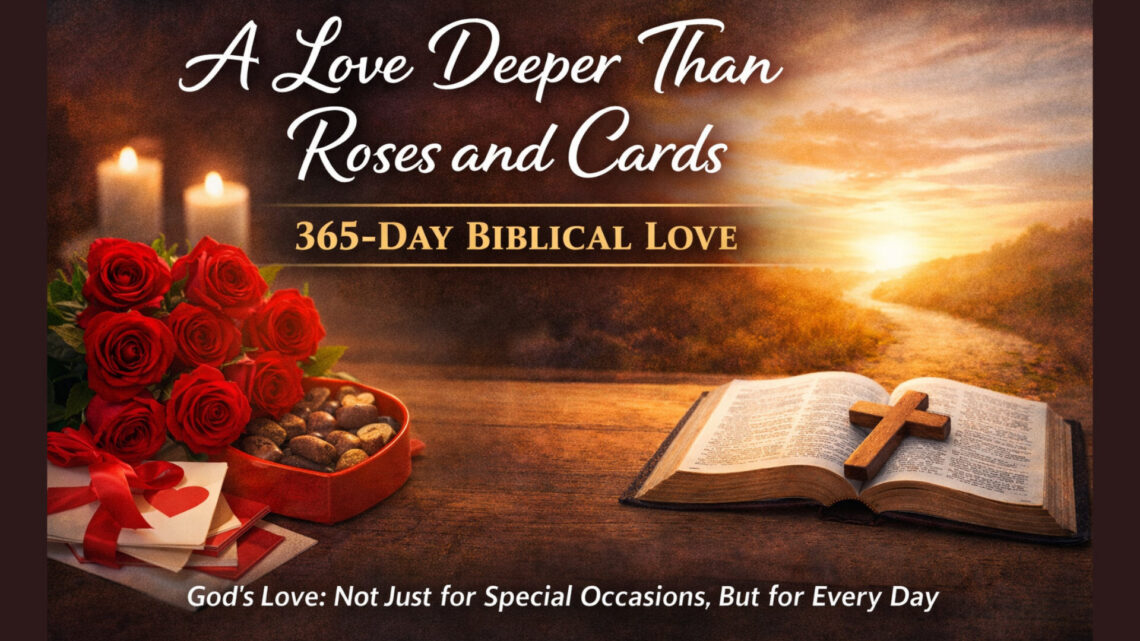
What the Bible Actually Says About Love
By Pastor John Haggard
Every year, as certain dates approach, store aisles transform — sometimes turning red and glowing with hearts, roses, chocolates, and cards as Valentine’s Day draws near. Then, as the calendar rolls on, those same aisles shift again, dressing up for Easter, Mother’s Day, Christmas, birthdays, anniversaries, and other marked days that invite us to celebrate.
- For many people, depending on the event, it’s a sweet and meaningful celebration.
- For others, it can feel commercialized, emotionally heavy, or even painful.
- But regardless of how one sees it, Scripture makes something unmistakably clear: love was never designed to be confined to one day on the calendar.
So what does the Bible say about love? Biblical love is deeper, broader, and far more enduring than roses and cards. Scripture pushes us beyond special-occasion love. It calls us to a love that is consistent, rooted, and durable — because it flows from God Himself and is shaped by His truth.
Love Begins With God, Not With a Calendar
The Bible doesn’t present love as a cultural invention; it presents love as a divine reality. The Apostle John, one of the inner circle of Jesus’ twelve disciples and by profession a fisherman, wrote down the Holy Spirit-inspired word of God in describing who God is:
1 John 4:8 (LSB):
“The one who does not love does not know God, because God is love.”
- Love is not whatever we feel in the moment. Love is not a feeling.
- Real love is anchored in God’s character — obedient, holy, truthful, faithful, and purposeful. And because God’s love is not seasonal or based on celebratory moments, our love shouldn’t be either.
- Scripture presents God’s love as steady and sustaining — especially visible in how He cares for His people day by day:
Lamentations 3:22–23 (LSB):
“The lovingkindnesses of Yahweh indeed never cease, For His compassions never fail. They are new every morning; Great is Your faithfulness.”
New every morning. That’s the cadence of biblical love. Not “once a year.” Not “when it’s convenient.” Not “when I feel appreciated.”
What Is the Difference Between Sentiment and Substance?
Valentine’s Day love, or “single day event” love, often majors on sentiment — feelings, romance, attraction, and mood. Biblical love can include affection, but it never reduces love to a feeling. Biblical love is covenantal and active.
Jesus defines the shape of love with a startling kind of realism:
John 15:13 (LSB):
“Greater love has no one than this, that one lay down his life for his friends.”
- That verse isn’t about balloons, chocolate, flowers, or special events. It’s about sacrifice. And it implies something crucial: the deepest love is often costly, unseen, and repetitive.
- Love is not primarily proven by what we give on a holiday; it’s proven by what we carry, endure, and choose in the ordinary grind of life.
- That’s why 1 Corinthians 13 doesn’t read like a greeting card. It reads like a mirror:
1 Corinthians 13:4–7 (LSB):
“Love is patient, love is kind, is not jealous, does not brag, is not puffed up; it does not act unbecomingly, does not seek its own, is not provoked, does not take into account a wrong suffered; it does not rejoice in unrighteousness, but rejoices with the truth; it bears all things, believes all things, hopes all things, endures all things.”
The Cross: The World’s Clearest Definition of Love
If you want a definition of love that no holiday can compete with, look to the cross. Scripture says:
Romans 5:8 (LSB):
“But God demonstrates His own love toward us, in that while we were yet sinners, Christ died for us.”
- God didn’t love us when we finally became worthy.
- He loved us while we were still rebellious. That kind of love isn’t merely affectionate; it’s redeeming. It moves toward sinners to rescue them. It acts in truth and holiness to do what we could never do for ourselves.
- This is where biblical love becomes different from the world’s version. Cultural love often says, “I’ll love you if you meet my needs.” Gospel love says, “I will seek your good, even at cost to myself,” because that is how God has loved us. The Apostle John wrote:
1 John 4:19 (LSB):
“We love, because He first loved us.”
So the deeper love we want to practice is not generated by man’s willpower. It is fueled by a prior love received.
What Jesus Said about Love
When Jesus was asked about the greatest commandment, He didn’t give a holiday answer. He gave a total-life answer:
Matthew 22:37 (LSB):
“YOU SHALL LOVE THE LORD YOUR GOD WITH ALL YOUR HEART, AND WITH ALL YOUR SOUL, AND WITH ALL YOUR MIND.”
Note: Words that are capitalized represent words quoted from the Old Testament (God speaking in Deuteronomy 6:5 in this case).
Matthew 22:39–40 (LSB):
“And the second is like it, ‘YOU SHALL LOVE YOUR NEIGHBOR AS YOURSELF.’ On these two commandments hang the whole Law and the Prophets.”
That kind of love is comprehensive. It covers private thoughts, public speech, money decisions, forgiveness choices, temptations resisted, and service offered. It is not limited to romantic relationships either — love extends to neighbors, spouses, children, fellow believers, strangers, and even enemies.
Jesus goes further:
Matthew 5:44 (LSB):
“But I say to you, love your enemies and pray for those who persecute you.”
This makes it quite clear that God loves everyone, including His adversaries. God’s indiscriminate benefits are a manifestation of his universal love. This is what theologians call “common grace.” This is a genuine kindness, but it must be distinguished from the eternal love God has for the elect.
Holiday love rarely survives offense. Biblical love absorbs offense and continues in obedience.
What Does 365-Day Love Look Like in Real Life?
A love deeper than celebratory moments doesn’t require grand gestures. It requires humility (who you truly are on the inside) and humbleness (how your humility shows up on the outside).
- Love is patient when you want to snap back (1 Corinthians 13:4).
- Love is kind when you feel unseen (1 Corinthians 13:4).
- Love forgives when pride wants repayment (Colossians 3:13).
- Love serves without keeping score (Mark 10:45).
- Love speaks truth with humility (Ephesians 4:15).
- Love keeps showing up — especially when it’s ordinary.
Paul summarizes love’s daily aim like this:
1 Corinthians 16:14 (LSB):
“Let all that you do be done in love.”
All. Not some. Not once a year.
What Is a Better Way to Celebrate Love?
When love is treated like an annual celebration, it becomes fragile. When love is treated like a lifelong calling, it becomes strong.
You can still enjoy Valentine’s Day, Easter, Mother’s Day, Christmas, birthdays, anniversaries, and other marked days — but you can’t depend on just those days to prove love.
The truest love is not measured by one impressive moment. It’s measured by a steady life shaped by Christ, a love rooted in God’s character, defined by the cross, guided by truth, and practiced in daily faithfulness.
Roses fade. Cards get thrown away. But the love God calls us to is built to endure — because it comes from the One whose compassions are new every morning.
If You Only Read One Verse on Love, Read This One
2 Corinthians 12:15 (LSB):
“So I will most gladly spend and be fully spent for your souls. If I love you more, am I to be loved less?”
A close inspection of this verse shows that Paul is describing a Christlike, self-emptying love — one that gives without keeping score, serves without demanding reciprocation, and remains committed even when that love is misunderstood or unappreciated. In other words, it’s 24/7 (twenty-four hours a day, 7 days a week), not momentary or shown only when something is wanted in return.
Love worth living is 365 days a year.
Learn More
To continue studying what the Bible teaches, you may also enjoy these related articles on TreasureTop:
- What Does It Mean to Be Born Again?
- How Do I Know If I Am Really Saved?
- Do Not Be Deceived: What the Bible Says About False Preachers
- What We Believe
Send Us Your Prayer Request
2 Questions Many Ask
- Am I Truly Saved? Discover the answer — 👉 Click here.
- Why Self-Help Books Don’t Work Long-Term: 👉 Find out. Click here.
Prayer Request?
- If you have a prayer request or comments, 👉 click here.
Find Us Here
- Visit our YouTube channel by clicking here.
- Visit our Facebook page here.
- Subscribe to our audio podcasts:
Scripture quotations taken from the New American Standard Bible 1995® (NASB), Copyright © 1960, 1962, 1963, 1968, 1971, 1972, 1973, 1975, 1977, 1995 and from the Legacy Standard Bible © 2021 by The Lockman Foundation. All rights reserved. www.lockman.org