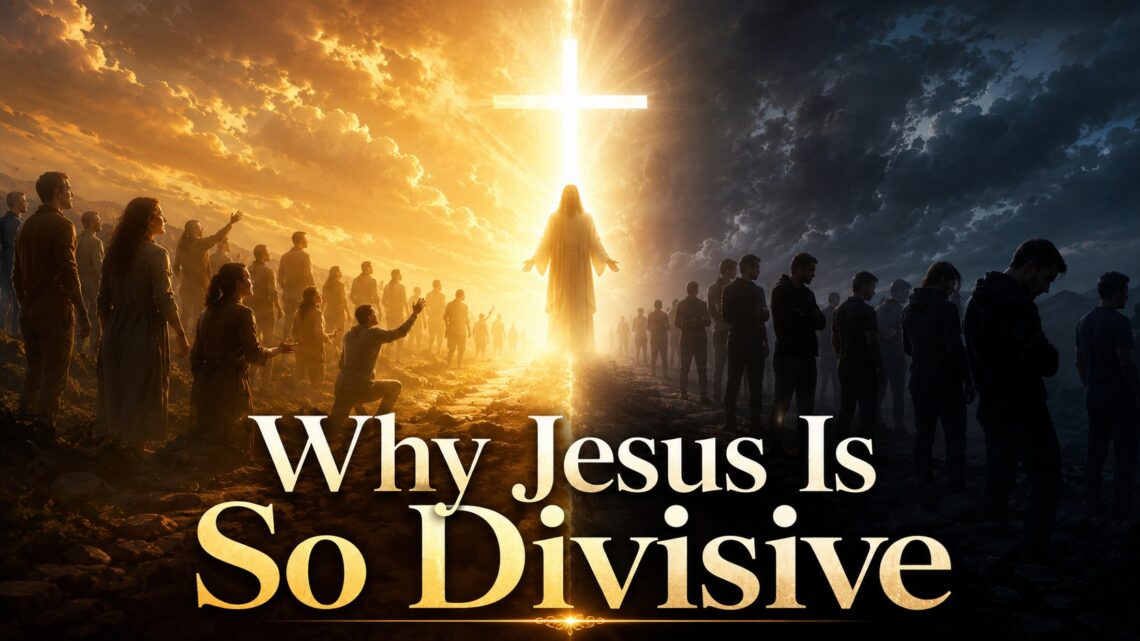
Why Is Jesus So Divisive?
A Sword, Not Peace: What Jesus Actually Said
By Pastor John Haggard
Why does the simple mention of the name Jesus Christ stir such strong reactions?
No name divides people the way the name of Jesus does. When He walked the earth more than 2,000 years ago, He divided crowds, families, religious leaders, political powers, and ordinary people. He still does today.
That may surprise people who think of Jesus only as gentle, kind, and peaceful. He is all of those things. But Jesus Himself said something many people do not expect.
Matthew 10:34–36 (LSB):
Do not think that I came to bring peace on the earth; I did not come to bring peace, but a sword. For I came to SET A MAN AGAINST HIS FATHER, AND A DAUGHTER AGAINST HER MOTHER, AND A DAUGHTER-IN-LAW AGAINST HER MOTHER-IN-LAW; and A MAN’S ENEMIES WILL BE THE MEMBERS OF HIS HOUSEHOLD.
Luke records the same truth in Luke 12:51–52 (LSB), where Jesus said:
Do you think that I came to grant peace on earth? I tell you, no, but rather division; for from now on five members in one household will be divided, three against two and two against three.
What did Jesus mean?
He was not talking about a literal sword. We know that because when Peter used a sword in the Garden of Gethsemane, Jesus rebuked him. Jesus was talking about the unavoidable result of following Him. The intention of Christ is reconciliation between sinners and God. But the effect of His coming is often division between those who receive Him and those who reject Him.
The moment a person becomes a true disciple of Christ, allegiance changes. Jesus is no longer a religious idea. Christ ceases to be an abstract theological proposition and instead becomes the sovereign Lord who demands total submission of the will. This is where genuine spiritual conflict arises because lordship demands the displacement of competing authorities and the subordination of one’s autonomous self-determination to Christ’s authority. That is where the conflict begins.
A Division Foretold by the Prophet Micah
Jesus’ words about household division also echo Micah the prophet, who wrote about 750 years before Christ was born:
Micah 7:6 (LSB):
For son treats father as a wicked fool; Daughter rises up against her mother, Daughter-in-law against her mother-in-law; A man’s enemies are the men of his own household.
Micah spoke of a time when even close family relationships would be marked by hostility and betrayal. Jesus applies that language to His own coming. The arrival of the Messiah would not bring universal earthly agreement. It would reveal where every heart truly stands before God.
The Crowd Divided at the Festival of Booths
We see the same thing in John 7. At the Festival of Booths, the people were divided over who Jesus was.
John 7:40–44 (LSB):
Some of the crowd therefore, when they heard these words were saying, ‘This truly is the Prophet.’ Others were saying, ‘This is the Christ.’ Still others were saying, ‘No, for is the Christ going to come from Galilee? Has not the Scripture said that the Christ comes from the seed of David and from Bethlehem, the village where David was?’ So a division occurred in the crowd because of Him. Some of them were wanting to seize Him, but no one laid hands on Him.
That is the pattern throughout history. Jesus is not merely one religious leader among many. He presses every person toward a verdict.
But to understand why Jesus is so divisive, we must first understand why He came.
Why Jesus Came: Fully God and Fully Man
The Bible teaches that Jesus Christ was conceived in the womb of the virgin Mary by the Holy Spirit.
Matthew 1:18 (LSB):
Now the birth of Jesus Christ was as follows: when His mother Mary had been betrothed to Joseph, before they came together she was found to be with child by the Holy Spirit.
Jesus is fully God and fully man.
John 1:14 (LSB):
And the Word became flesh, and dwelt among us, and we beheld His glory, glory as of the only begotten from the Father, full of grace and truth.
The eternal Son of God took on real humanity. He came in human form so we could know Him, see the glory of God in Him, and understand that He entered the human condition. He felt hunger, pain, sorrow, rejection, temptation, and suffering just like we do, yet without sin.
For a little while, He was made lower than the angels. That humiliation was purposeful. He took on flesh so that He could die a real death. He submitted Himself to the will of the Father so that He could fulfill the Scriptures and save His people from their sins.
Philippians 2:6–7 (LSB):
Who, although existing in the form of God, did not regard equality with God a thing to be grasped, but emptied Himself, by taking the form of a slave, by being made in the likeness of men.
Why was that necessary for Him to do?
The Cross: Why a Sinless Savior Was Necessary
Because all sin must be paid for.
Romans 6:23 (LSB):
For the wages of sin is death, but the gracious gift of God is eternal life in Christ Jesus our Lord.
Wages are payment. Sin earns death. The problem is not merely that people make mistakes. Every human being is born in sin, guilty before a holy God, and unable to save himself.
That is why Jesus came to earth. He came to die on the cross, pay for the sins of all who would believe in Him, and rise again on the third day. His resurrection is the believer’s hope and certainty. Those who are in Christ have been raised from spiritual death to new life, and one day they will also be raised bodily in glory.
Only Jesus could accomplish this. He knew no sin. He was perfect. A sinner cannot pay for another sinner’s guilt. But Jesus, the sinless Son of God, could stand in the place of sinners.
2 Corinthians 5:21 (LSB):
He made Him who knew no sin to be sin on our behalf, so that we might become the righteousness of God in Him.
1 Corinthians 15:21–22 (LSB):
For since by a man came death, by a man also came the resurrection of the dead. For as in Adam all die, so also in Christ all will be made alive.
Now we come back to the question: Why is Jesus Christ so divisive?
Why Jesus Is Divisive: The Heart That Wants Self-Rule
The major reason is that the natural human heart does not want to be accountable to anyone other than itself. The unbelieving heart wants self-rule, not surrender. It wants personal freedom without divine authority. It wants forgiveness without repentance, comfort without conviction, heaven without holiness, and the benefits of God without bowing before God.
Jesus does not allow that. A true Christian is called to put God first, not self first.
Matthew 22:37–40 (LSB):
And He said to him, ‘YOU SHALL LOVE THE LORD YOUR GOD WITH ALL YOUR HEART, AND WITH ALL YOUR SOUL, AND WITH ALL YOUR MIND.’ This is the great and foremost commandment. And the second is like it, ‘YOU SHALL LOVE YOUR NEIGHBOR AS YOURSELF.’ On these two commandments hang the whole Law and the Prophets.
This does not mean Christians are perfect and sinless; that’s why we need a Savior. True believers still sin. But a true believer confesses sin, repents of sin, asks forgiveness, and seeks to turn from repeated patterns of sin. This ongoing growth is called sanctification.
Conviction of sin and truth is offensive to the world because it says something people do not want to hear: sin is real, judgment is real, hell is real, and Christ is the only Savior.
No Middle Ground With Christ
Jesus also said few will enter into eternal spiritual life through the narrow gate.
Matthew 7:13–14 (LSB):
Enter through the narrow gate; for the gate is wide and the way is broad that leads to destruction, and there are many who enter through it. For the gate is narrow and the way is constricted that leads to life, and there are few who find it.
That is not an easy message. No one wants to be told that he is spiritually dead without Christ. No one naturally wants to hear that he is accountable to God. No one wants to be told that refusing Christ has eternal consequences.
But love tells the truth.
Jesus did not come to form a fan club. He came as Lord, Savior, Judge, King, and Redeemer. He does not leave people in comfortable neutrality.
Matthew 12:30 (LSB):
He who is not with Me is against Me; and he who does not gather with Me scatters.
With Jesus, there is no middle ground. A person either receives Him or rejects Him.
That is why the name Jesus divides.
In summary, Jesus divides light from darkness, truth from error, belief from unbelief, repentance from self-justification, and eternal life from eternal judgment. He exposes what is in the heart. He confronts sin. He demands allegiance. He offers mercy. He saves completely. And He warns plainly.
Take Heart When You Are Rejected for His Name
So do not lose heart when you are rejected, criticized, or persecuted for following Christ and proclaiming His name. Jesus told us this would happen. The division caused by Christ is not a failure of the Gospel. It is proof that the Gospel is doing what God intended: revealing the heart, calling sinners to repentance, and gathering His people to Himself.
Listen to the podcast full teaching by clicking here.
Watch a short 30-second video by clicking here.
Learn More
To continue studying what the Bible teaches, you may also enjoy these related articles on TreasureTop:
Send Us Your Prayer Request
2 Questions Many Ask
- Am I Truly Saved? Discover the answer — 👉 Click here.
- Why Self-Help Books Don’t Work Long-Term: 👉 Find out. Click here.
Prayer Request?
- If you have a prayer request or comments, 👉 click here.
Find Us Here
- Visit our YouTube channel by clicking here.
- Visit our Facebook page here.
- Subscribe to our audio podcasts:
Scripture quotations taken from the New American Standard Bible 1995® (NASB), Copyright © 1960, 1962, 1963, 1968, 1971, 1972, 1973, 1975, 1977, 1995 and from the Legacy Standard Bible © 2021 by The Lockman Foundation. All rights reserved. www.lockman.org