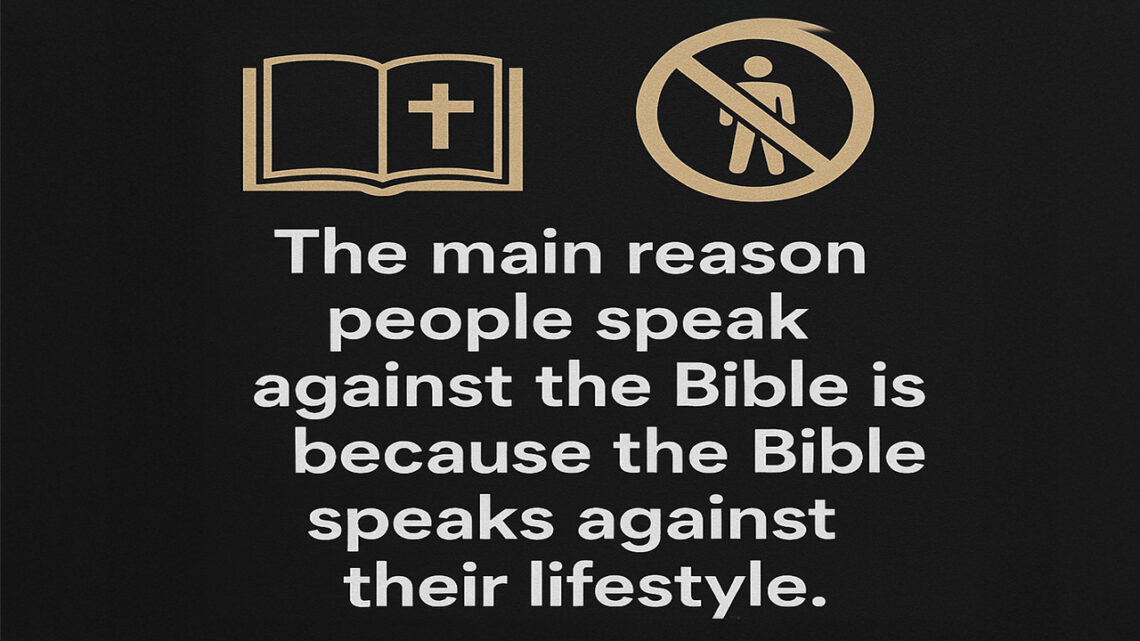
Why do people reject the Bible? There is no single explanation that applies to everyone. Some people resist Scripture because it confronts their sin and challenges their desire to live independently of God. Others misunderstand what the Bible teaches, struggle with difficult passages, or have been hurt by the hypocrisy of people who claimed to follow it. Still others doubt the Bible’s historical reliability or relevance.
The Bible does identify spiritual resistance to God’s truth, but Christians should not assume that they know every critic’s motives. Some objections are sincere questions. Others may be attempts to avoid God’s authority. A faithful response must combine biblical conviction with patience, humility, and grace.
The Bible Confronts Every Person
The Bible does not divide humanity into respectable people who need little correction and especially sinful people who need much correction. Scripture declares that everyone has sinned.
Romans 3:23 (LSB)
for all have sinned and fall short of the glory of God,
That truth applies to the person criticizing the Bible, but it also applies to the Christian defending it. Believers have been forgiven through faith in Jesus Christ, indwelt by the Holy Spirit, and called to grow in obedience. They have not earned a position of moral superiority.
Hebrews 4:12 describes the Word of God as “living and active” and able to judge the heart’s thoughts and intentions. Scripture exposes pride, greed, dishonesty, gossip, bitterness, anger, drunkenness, sexual immorality, idolatry, and every other form of rebellion against God. None of us stands outside its examination.
This is one reason the Bible can make people uncomfortable. It does not merely offer encouragement; it reveals our guilt, corrects our thinking, and calls us to repent and submit to God.
Reason 1: The Bible Challenges Moral Independence
Many people want the freedom to define right and wrong for themselves. The Bible does not grant us that authority. It teaches that God is our Creator and Judge, that His character defines what is good, and that His commands are not subject to popular opinion.
Jesus explained that sinful human beings do not naturally welcome the light of God’s truth.
John 3:19 (LSB)
the Light has come into the world, and men loved the darkness rather than the Light, for their deeds were evil.
When Scripture identifies something we love as sinful, we face a choice: submit to God or search for a reason to dismiss His Word. A person may attack the Bible because rejecting its authority seems easier than changing a cherished belief or behavior.
This moral resistance is a genuine biblical explanation for unbelief, but Christians must apply it carefully. We cannot see another person’s heart, and we should not use this truth to avoid answering serious questions. Only God knows whether an objection arises from confusion, pain, intellectual doubt, moral resistance, or some combination of these.
Reason 2: People Misunderstand What the Bible Teaches
Some people reject a teaching they believe is in the Bible without first examining what the passage actually says. A verse may be removed from its context, a description of sinful behavior may be mistaken for God’s approval, or an Old Testament command given specifically to Israel may be applied incorrectly to the church.
Christians can also contribute to misunderstanding when they explain Scripture carelessly, use it to win arguments, or live in ways that contradict what they profess. Hypocrisy does not make the Bible untrue, but it can become a serious stumbling block for someone who is trying to understand Christianity.
Honest questions are not the enemy of faith. The people of Berea were commended for receiving the message eagerly while also “examining the Scriptures daily to see whether these things were so” (Acts 17:11, LSB). The right response to a difficult passage is careful study—not immediate rejection and not a shallow answer.
When a passage seems confusing, consider its historical setting, literary form, immediate context, and place within the Bible’s complete message. Many alleged problems become clearer when Scripture is read in context. Our article Does the Bible Contradict Itself? explains how to evaluate apparent contradictions without ignoring difficult questions.
Reason 3: People Doubt the Bible’s Reliability or Relevance
Some objections are primarily intellectual. People may wonder whether the biblical text has been preserved accurately, whether its historical claims can be trusted, or whether an ancient collection of books can still speak meaningfully to modern life. These are legitimate subjects for careful investigation.
The challenge to God’s Word is not new. In Genesis 3:1, the serpent asked Eve, “Indeed, has God said?” He questioned God’s command, distorted its meaning, and encouraged human beings to distrust God’s character. That same basic challenge continues whenever God’s Word is treated as unreliable merely because it conflicts with human judgment.
Christians should not answer historical questions with slogans. The Bible makes claims about real people, places, and events, and those claims deserve thoughtful examination. Readers who want to investigate the evidence can begin with Is the Bible True? How to Test It for Yourself.
The Bible also remains relevant because human nature has not changed. People still struggle with guilt, pride, fear, suffering, temptation, injustice, broken relationships, and death. Most importantly, every generation needs the same truth about God, sin, judgment, grace, and salvation through Jesus Christ.
How Should Christians Respond to People Who Reject the Bible?
Christians are commanded to defend their hope, but the manner of that defense matters. First Peter 3:15 tells believers to be ready to give an answer “with gentleness and fear” (LSB). Biblical truth does not need an arrogant messenger.
When speaking with someone who criticizes Scripture:
- Listen long enough to understand the person’s actual concern.
- Ask questions instead of assuming motives.
- Read disputed passages in their full context.
- Admit when you need more time to study an answer.
- Distinguish the failures of Christians from the teaching of Christ.
- Speak clearly about sin without forgetting your own need for grace.
- Pray that God will open the person’s heart to understand His truth.
The goal is not merely to win an argument. The goal is to bear faithful witness to Christ. A calm, honest conversation may accomplish more than a forceful response that leaves no room for the other person to think or ask questions.
The Bible Offers Grace, Not Only Condemnation
The Bible exposes sin, but it does not stop with condemnation. Its central message is that guilty people can be forgiven and transformed through Jesus Christ.
After listing patterns of sin that characterized some of the Corinthians, Paul reminded the believers of what God had done for them.
1 Corinthians 6:11 (LSB)
And such were some of you; but you were washed,
No sinner is beyond Christ’s power to save. At the same time, salvation is not permission to continue in rebellion. Those who are truly born again according to the Bible are given new life and progressively changed by the Holy Spirit.
Ephesians 2:8 (LSB)
For by grace you have been saved through faith, and this not of yourselves, it is the gift of God;
We do not earn salvation by cleaning up our lives or winning a theological debate. God saves by grace through faith in Jesus Christ. The proper response to Scripture is therefore not self-righteousness or defiance, but humble repentance and faith.
Conclusion
Why do people reject the Bible? Some resist its moral authority, some misunderstand its message, and others doubt its reliability or relevance. These reasons can overlap, and only God perfectly knows the human heart.
Christians should never weaken what Scripture teaches in order to make it more acceptable. We should also never use the truth as an excuse for pride or needless hostility. Our responsibility is to explain God’s Word accurately, answer sincere questions patiently, live consistently with what we profess, and point people to the grace offered in Jesus Christ.
Key Takeaway
People reject the Bible for moral, personal, and intellectual reasons. Christians should respond with clear biblical truth, careful listening, humility, and the good news that forgiveness and new life are available through Jesus Christ.
Learn More
To continue studying what the Bible teaches, you may also enjoy these related articles on TreasureTop:
- Is the Bible True? How to Test It for Yourself
- Does the Bible Contradict Itself?
- What Does Born Again Mean According to the Bible?
- How to Know If You Are Really Saved
Send Us Your Prayer Request
2 Questions Many Ask
- Am I Truly Saved? Discover the answer — 👉 Click here.
- Why Self-Help Books Don’t Work Long-Term: 👉 Find out. Click here.
Prayer Request?
- If you have a prayer request or comments, 👉 click here.
Find Us Here
- Visit our YouTube channel by clicking here.
- Visit our Facebook page here.
- Subscribe to our audio podcasts:
Scripture quotations taken from the New American Standard Bible 1995® (NASB), Copyright © 1960, 1962, 1963, 1968, 1971, 1972, 1973, 1975, 1977, 1995 and from the Legacy Standard Bible © 2021 by The Lockman Foundation. All rights reserved. www.lockman.org